
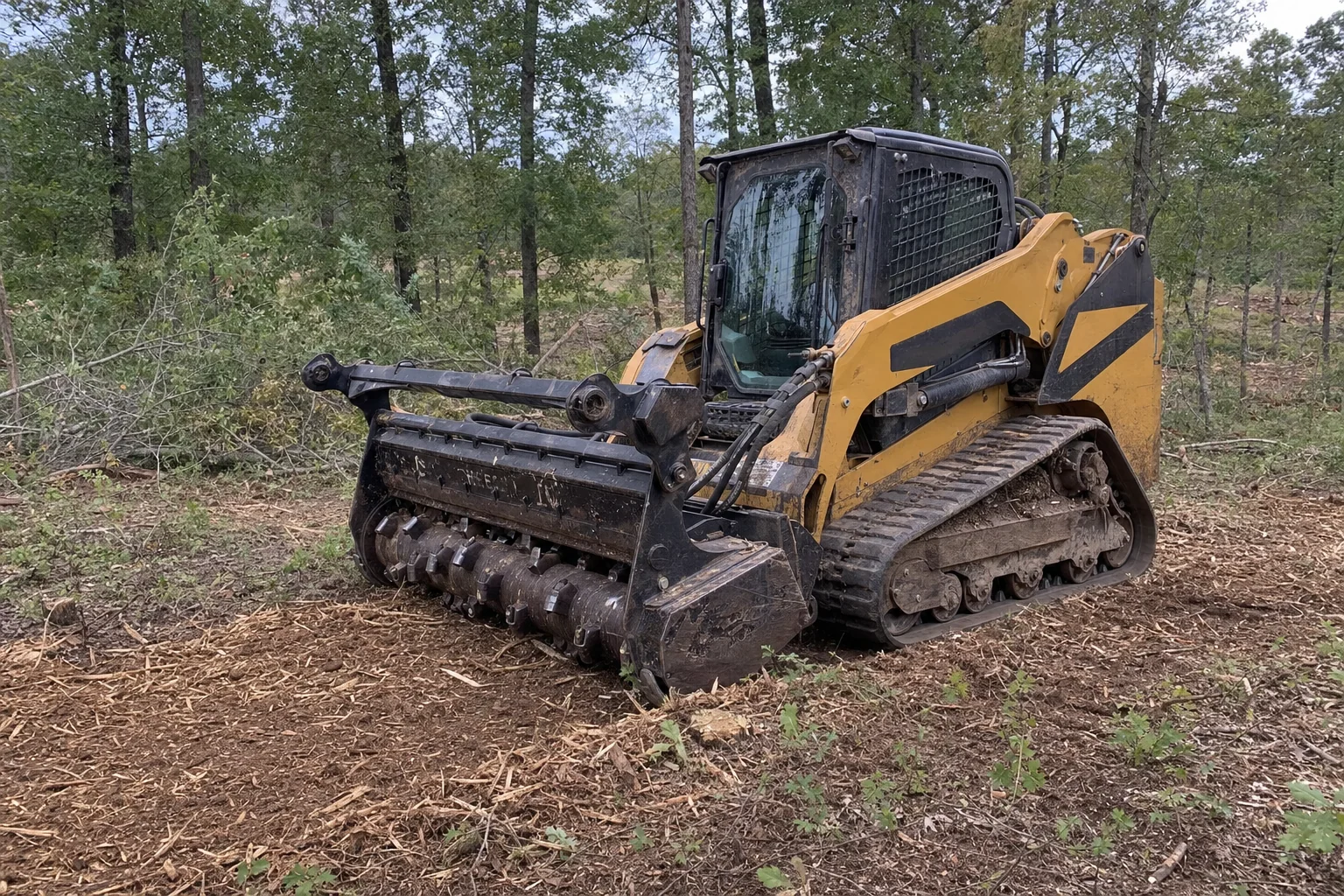
How the work is approached
The operator works around marked trees and obstacles, cutting suitable vegetation with a forestry head. The head and machine must match the material, slope and working room.
What the finish looks like
Expect processed woody material on the surface. Stumps can remain at or near ground level, and the root system is generally left in place.
What this does not include
A mulched finish is not a finished lawn or a foundation-ready pad. Mulching does not guarantee that resprouting species are permanently controlled.
Where the material goes
The mulch remains on site. Depth and consistency depend on the vegetation and agreed finish; extra processing is a separate part of the scope.
What changes the estimate
Trunk size, density, rocks, wire, visibility, terrain and the desired mulch finish affect machine time. A day rate alone does not predict acres completed.
What happens afterward
Plan follow-up mowing or vegetation management as needed. Discuss grubbing where a driveway, utility trench or structural pad will go.
A few straight answers
Does mulching take out the roots?
Usually it does not. If roots must be removed, that is a grubbing scope and should be priced separately.
Can I build directly over the mulch?
Building areas need the preparation specified by your builder or engineer. Organic material and roots should not be assumed suitable beneath a structure.
Method reference: Texas A&M Forest Service — vegetation management. Construction disturbance and runoff: TCEQ guidance. Site-specific requirements still need review.